
Freight density measures weight per unit of shipping space. Freight class is part of the classification used for less-than-truckload (LTL) freight. The National Motor Freight Classification (NMFC) is maintained by the National Motor Freight Traffic Association (NMFTA). Some NMFC provisions assign a class through a density scale, but a density calculation does not identify the applicable item. Density is shown in pounds per cubic foot (lb/ft³).
The density-based freight class tool maps each handling unit to a 13-tier scale. For example, 9 lb/ft³ falls in the 8 to under 10 band and produces a Class 100 estimate. Use that estimate only after confirming that the actual item's governing provision uses this scale.
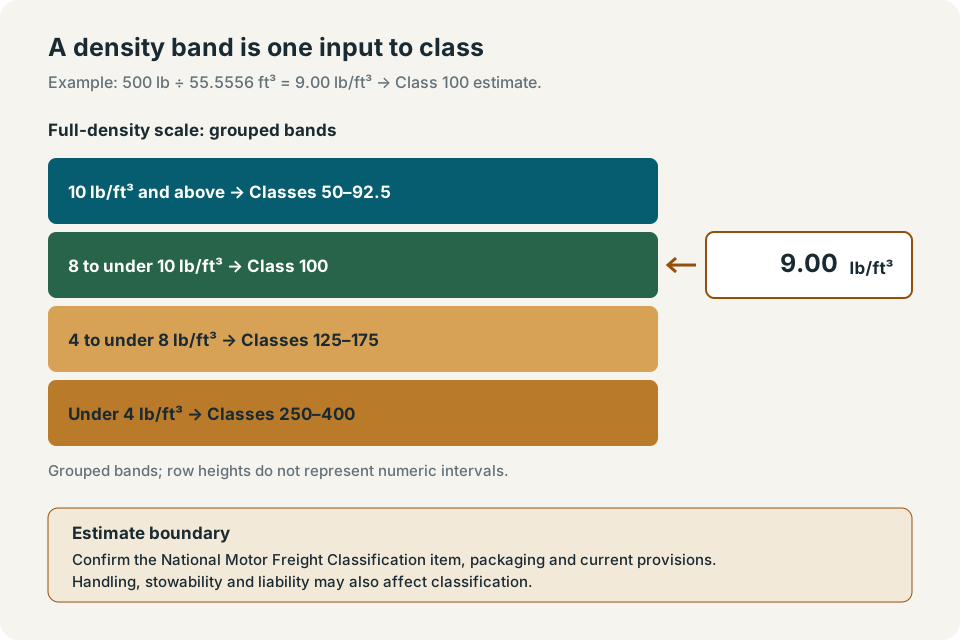
Confirm the item before applying a scale
Start with an accurate description of the commodity, its packaging and the way it will be handled. Confirm the applicable NMFC item and provisions through the carrier or the classification resources used for the shipment. Do not select an item because its density band gives a preferred class.
| Question | Available here | Separate confirmation |
|---|---|---|
| What is the unit's density? | Gross weight divided by outside rectangular volume | Correct tendered dimensions and measured gross weight |
| Which band contains that density? | The 13-tier mapping shown below | Whether that scale governs the applicable item |
| What is the correct NMFC item? | No item lookup | Commodity, packaging and current item provisions |
| What will the carrier bill? | No tariff or agreement lookup | Applicable class, rates, service charges and agreement terms |
Handling, stowability and liability are classification considerations as well as density. A carrier agreement may also affect rating. The table here should not be substituted for a different item-specific scale or for a classification committee's separate density guidance.
Enter one measured handling unit per row
- Select U.S. input for inches and pounds or metric input for centimeters and kilograms.
- Enter outside length, width and height, including the pallet and shipping packaging where they are part of the unit.
- Enter gross weight per handling unit and the number of identical units.
- Add separate rows for unlike units and calculate. Read each unit's estimate separately.
Dimensions and gross weight must be positive. Identical-unit quantity must be a positive whole number. Quantity repeats an estimate for identical units; it does not multiply the weight used to calculate one unit's density. The tool does not blend different commodities into an official shipment class.
Volume (ft³) = outside length × width × height (in) ÷ 1,728Density (lb/ft³) = gross weight per unit (lb) ÷ volume per unit (ft³)Read the 13-tier full-density scale
Each lower limit is inclusive; each upper limit is exclusive. For example, exactly 8 lb/ft³ is in Class 100's band, while a positive value below 8 and at least 6 lb/ft³ is in Class 125's band.
| Density, lb/ft³ | Estimated class |
|---|---|
| 50 and above | 50 |
| 35 to under 50 | 55 |
| 30 to under 35 | 60 |
| 22.5 to under 30 | 65 |
| 15 to under 22.5 | 70 |
| 12 to under 15 | 85 |
| 10 to under 12 | 92.5 |
| 8 to under 10 | 100 |
| 6 to under 8 | 125 |
| 4 to under 6 | 175 |
| 2 to under 4 | 250 |
| 1 to under 2 | 300 |
| Positive density under 1 | 400 |
This is the tool's mapping, not a statement that every NMFC item uses all 13 bands. Confirm the provisions effective for the shipment date before using an estimate in shipping paperwork.
Worked example: 9.00 lb/ft³ and a Class 100 estimate
Calculate density and find the band
| Step | Input or arithmetic | Result |
|---|---|---|
| Outside dimensions and gross weight | 48 × 40 × 50 in; 500 lb; quantity 1 | One complete unit |
| Outside volume | 48 × 40 × 50 ÷ 1,728 | 55.555555… ft³ |
| Density | 500 ÷ (48 × 40 × 50 ÷ 1,728) | 9 lb/ft³ |
| Scale mapping | 8 ≤ 9 < 10 | Class 100 estimate |
Check what the displayed estimate means
The tool displays volume and density to at most 3 decimal places, so the volume appears as 55.556 ft³. It uses unrounded density for the estimate. The written 9.00 lb/ft³ above is the same value as the displayed 9 lb/ft³.
A Class 100 result is useful only if the actual item uses this scale. It does not confirm the item, packaging compliance, negotiated rating terms or the carrier's final classification.
See how measurements and rounding affect a band
| Outside height | Volume | Density | Scale estimate |
|---|---|---|---|
| 40 in | 44.444444… ft³ | 11.25 lb/ft³ | Class 92.5 |
| 50 in | 55.555555… ft³ | 9 lb/ft³ | Class 100 |
| 60 in | 66.666666… ft³ | 7.5 lb/ft³ | Class 125 |
Near a breakpoint, the rounded display can hide the distinction. A 48 × 40 × 45 in unit at 399.98 lb has 50 ft³ of volume and an unrounded density of 7.9996 lb/ft³. Its displayed density rounds to 8, but its estimate remains Class 125 because the unrounded value is below 8.
Use actual dimensions and measured weight. These comparisons explain sensitivity; they are not a reason to alter shipment descriptions or measurements to obtain a different class.
Keep unlike freight and governing rules separate
The general density calculator can report one physical density for several rows. That aggregate does not establish an official class for mixed freight. Apply the provisions for the actual commodities and shipment, including any item-specific or mixed-shipment rules. Docket proposals do not change the arithmetic shown here; confirm which provisions are effective on the shipment date.
The estimate also does not identify an NMFC item, retrieve ClassIT+ data, determine a freight-all-kinds agreement or calculate a rate. A correct arithmetic result can still be unsuitable for a particular classification task.
Use the estimate after confirming the classification basis
Measure the freight first. Use the density calculator to check physical density, then use the class estimate only when the applicable item uses its scale. Keep the confirmed item and governing terms with the shipment record rather than relying on a class number alone.
FAQs
Is the displayed class an official NMFC classification?
No. It is a result of the calculator's density mapping. Confirm the item and its effective provisions before using a class for a shipment.
Does every item use the same 13 density tiers?
No. Use this scale only when the applicable item and provisions call for it. The calculator does not look up the commodity or select its item.
Sources
These references support the methods or rules used on this page. Check the version effective for your shipment date and any applicable carrier terms or item-specific provisions.