
Read the test name before comparing the rating
A number on a corrugated box can describe a board test, a finished-box test or a limit stated in a box specification. Those numbers answer different questions. Identify the test, units and construction before deciding whether two boxes have comparable ratings.
This reference explains the markings and inputs used by the box compression estimator and stacking-load calculator. An edge crush test (ECT) rating is not a product-weight allowance, and an estimated box compression test (BCT) value is not a laboratory test result.
Separate board properties from finished-box strength
| Term | Meaning | Important distinction |
|---|---|---|
| ECT: edge crush test | Edgewise compression resistance of a board specimen, commonly expressed in lb/in in U.S. specifications. | Describes the board specimen, not the entire loaded box. |
| Burst or Mullen test | Pressure required to rupture a board specimen, commonly expressed in psi. | A pressure rating is not interchangeable with an ECT force-per-length rating. |
| BCT: box compression test | Compression force measured on a box under specified conditions. | Identify whether the number was measured or estimated, and how the specimen was prepared. |
| Single-wall or double-wall | One or two corrugated medium layers between linerboards. | Wall count does not supply a complete strength grade. |
| Flute designation and caliper | The corrugated profile and measured board thickness. | Use measured caliper in the estimator; a flute letter alone is not a thickness measurement. |
Read a box maker's certificate field by field
Locate the maker, test designation, rating and any stated size or gross-weight limits. Actual wording and layout vary. Photograph the real marking and retain the supplier's specification if a field is unclear.
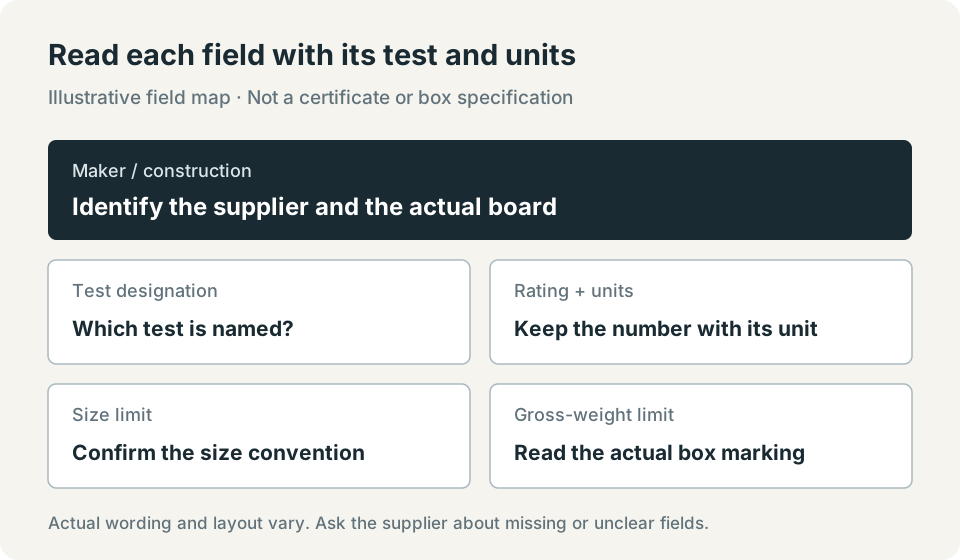
Keep the test name beside its units when recording a value. Ask what dimension convention applies to a size limit. Read a marked gross-weight limit as part of that box specification; it does not separately verify stack height, exposure to humidity or the support provided by the contents.
Worked example: estimate compression from measured board inputs
The compression estimator uses the simplified McKee equation for a regular slotted corrugated box. Enter inside length, inside width, measured ECT and measured board caliper. All four values must be positive.
Inside perimeter P = 2 × (inside length + inside width)Estimated BCT = 5.87 × ECT × √(P × caliper)The coefficient shown requires ECT in lb/in and perimeter and caliper in inches. Metric mode converts dimensional inputs from centimeters, but ECT remains lb/in. The output's lb value represents compression force; it is not the mass of product that may safely be packed. The calculator also displays kilogram-force (kgf), a force conversion rather than a box-weight allowance.
| Input or step | Value or calculation |
|---|---|
| Inside length × width | 12 × 10 in |
| Measured ECT; measured caliper | 32 lb/in; 0.25 in |
| Inside perimeter | 2 × (12 + 10) = 44 in |
| Estimated compression | 5.87 × 32 × √(44 × 0.25) = 622.9948006… lb |
| Displayed estimate | 622.995 lb; 282.586 kgf equivalent; approximately 623 lb to the nearest pound |
The tool displays up to 3 decimal places. That display precision does not imply laboratory accuracy. Box construction, moisture, manufacturing, loading duration and handling can change actual performance.
Compare a stack using a separately measured BCT
For a stacking check, use a BCT measured for the actual box and relevant conditions. The following is a separate example using 1,200 lb measured BCT; it does not use the 622.995 lb estimate above. Enter 32 lb gross per box, 10 tiers, no additional top load, an entered factor of 4, 8 in box height and 6 in pallet height.
| Check | Calculation | Result |
|---|---|---|
| Load on the bottom box | 32 × (10 − 1) + 0 | 288 lb |
| Allowable load at the entered factor | 1,200 ÷ 4 | 300 lb |
| Comparison | 288 ≤ 300 | Within entered load limit |
| Maximum tiers under those inputs | ⌊(300 − 0) ÷ 32⌋ + 1 | 10 tiers |
| Overall stack height | 6 + 10 × 8 | 86 in |
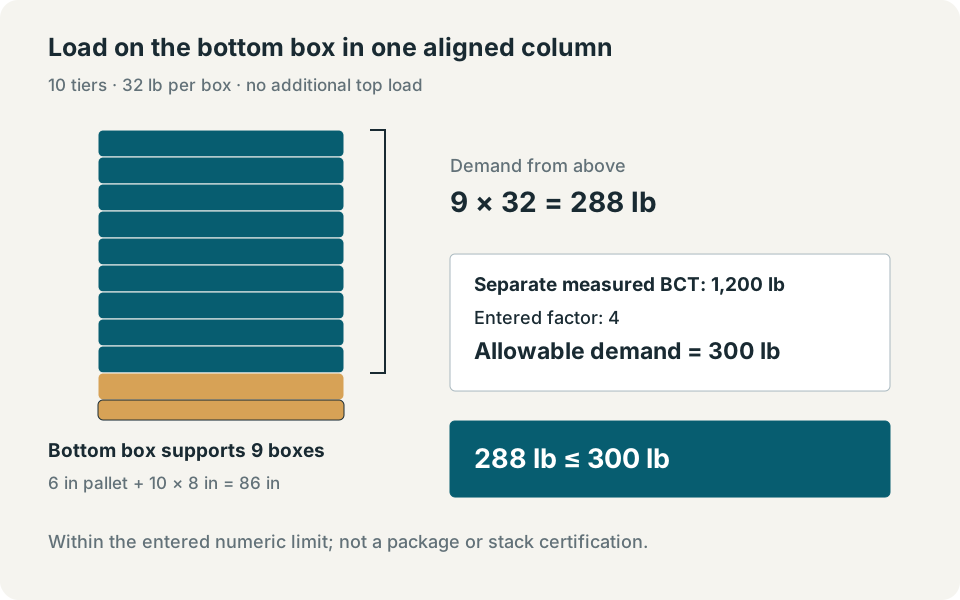
The stack tool requires positive BCT, gross box weight, factor and box height; tiers must be a positive whole number. Additional top load and pallet height cannot be negative. It does not model the effects of offset stacking, pallet support, humidity, time or damage.
Keep the specification and the evidence together
Record the actual marking, units, board construction and test conditions before comparing boxes. Use compression and stack calculations to examine those stated inputs, then validate the packed product for its intended distribution conditions. A numeric result within an entered limit does not certify the package.
FAQs
Can I convert an edge crush test (ECT) rating directly into a safe carton weight?
No. ECT describes a board test. The compression estimator uses ECT as one input to an empirical box model, and the result is not a tested safe product weight.
Can an estimated box compression test (BCT) value be entered as measured BCT?
No. Keep estimated and laboratory-measured values distinct. The stacking comparison depends on the BCT value you enter and the factor you select.