
Choose a structure before specifying the box
A corrugated box style describes how the body, flaps and cover are constructed. It helps you explain the package you want to a supplier. It does not establish the inside fit, board grade or strength of the finished package.
Use the structure reference below alongside the carton size planner. The planner calculates an envelope for a chosen product arrangement. A supplier must translate that envelope into the actual box design, including folds, scores, flaps and manufacturing allowances.
Compare four common structures
Regular slotted container (RSC)
A one-piece slotted box has four flaps at each end. On a conventional RSC, the outer flaps meet at the center when closed.
Confirm with the supplier: Confirm inside dimensions, the center seam and the specified tape or adhesive. The style name does not specify board strength.
Full-overlap slotted box
The outer flaps overlap across the opening. The overlap distinguishes its closure from the meeting flaps of an RSC.
Confirm with the supplier: Confirm the actual overlap and closing method. Extra flap material does not, on its own, establish a tested compression rating.
Telescoping box
A separate cover fits over a body. The depth of the cover and its fit over the body are part of the design.
Confirm with the supplier: Identify both pieces, assembled outside dimensions, cover depth and the method that keeps the package together.
Tray or open-top style
A base and side walls leave the top open unless a separate cover, sleeve or other closure is supplied.
Confirm with the supplier: State whether the shipment uses an open tray or a complete covered assembly. Confirm how the contents are restrained.
These original sketches explain the structural differences. They are not cutting dies or manufacturing drawings. A recognized corrugated-box style code can identify a more specific construction, but it still needs dimensions and a complete material specification.
| Decision | Information to supply | What still needs confirmation |
|---|---|---|
| Structure | Body, cover, flap arrangement and closure method | Exact supplier design and assembled package |
| Inside fit | Product arrangement, gaps and clearance at each wall | Usable dimensions after inserts and manufacturing tolerances |
| Outside envelope | Nominal board thickness and assembled dimensions | Actual closed shipping dimensions |
| Performance | Board specification, relevant tests and shipping conditions | Suitability of the complete packed product |
Enter a product arrangement in the carton size planner
- Enter the outside length, width and height of one product or its immediate package. Keep each side aligned with the arrangement you are planning.
- Enter the whole number of products along length, across width and in height. The planner does not choose the arrangement for you.
- Enter the gap between adjacent products. This gap is added only between neighbors.
- Enter clearance at each wall. The planner adds it at both ends of every axis.
- Enter nominal board thickness per wall, then review both inside and nominal outside dimensions.
Inside side = product side × count + gap × (count − 1) + 2 × wall clearanceNominal outside side = inside side + 2 × board thicknessProduct dimensions must be positive. Arrangement counts must be positive whole numbers. Gaps, wall clearance and board thickness can be zero, but cannot be negative. In metric mode, all these length inputs use centimeters.
Worked example: a carton for 24 products
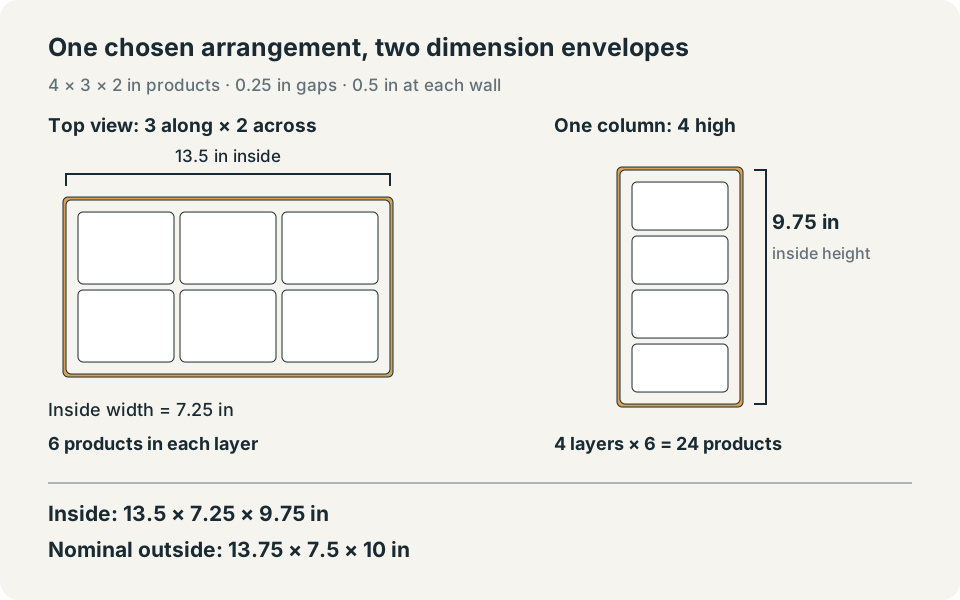
Place 4 × 3 × 2 in products in a 3 × 2 × 4 arrangement. Enter a 0.25 in gap between neighbors, 0.5 in clearance at each wall and 0.125 in board thickness per wall. These are illustrative design inputs, not recommended protection or board specifications.
| Axis | Inside dimension calculation | Inside result | Nominal outside result |
|---|---|---|---|
| Length | 4 × 3 + 0.25 × 2 + 2 × 0.5 | 13.5 in | 13.5 + 2 × 0.125 = 13.75 in |
| Width | 3 × 2 + 0.25 × 1 + 2 × 0.5 | 7.25 in | 7.25 + 0.25 = 7.5 in |
| Height | 2 × 4 + 0.25 × 3 + 2 × 0.5 | 9.75 in | 9.75 + 0.25 = 10 in |
The arrangement contains 3 × 2 × 4 = 24 products. The planner returns 13.5 × 7.25 × 9.75 in inside and 13.75 × 7.5 × 10 in nominal outside. Its display allows up to 3 decimal places; no intermediate rounding is needed for these inputs.
Turn the dimensions into a supplier specification
Give the supplier the selected structure, dimension order, usable inside dimensions, board requirements and closure method. Obtain an assembled sample or approved drawing where inserts, tight clearances or a separate lid affect fit. Measure the closed package before using its outside dimensions in a pallet or carrier-size calculation.
For a fixed bundle and a list of available boxes, use the shipping box selector. For a uniform count inside a known carton, use the products-per-carton calculator. Neither tool selects a box style or validates protective packaging.
Order the complete package, not just a style name
Choose the structure for the packing and opening process, calculate the space your arrangement requires, and confirm the manufactured package with the supplier. Keep the approved structure, inside fit, outside envelope and performance requirements together so a change to one does not silently change the others.
FAQs
Does the carton size planner produce a cutting die?
No. It calculates a rectangular inside arrangement and nominal outside envelope. It does not calculate flaps, folds, scores or supplier manufacturing allowances.
Can a box-style name identify the complete package?
No. Specify the construction, dimensions, board and closure separately, and confirm the supplier's assembled design.