
Select a strap system, then estimate its consumption
Strapping material affects how a package can be tensioned, joined and handled. Selecting polypropylene (PP), polyester (PET) or steel is only part of the decision: the strap grade, dimensions, joint, tool and package must work together.
Use this reference to prepare a supplier discussion, then use the pallet strapping length calculator to estimate consumption for an entered route. The calculator does not choose a material, prescribe strap tension or establish a safe restraint capacity.
Compare polypropylene, polyester and steel
| Material | Useful distinction | Questions for the supplier |
|---|---|---|
| Polypropylene (PP) | A plastic strap family used for bundling and many carton-handling tasks. | Which width, thickness and grade does the tool accept? What tension retention does the actual package require? |
| Polyester (PET) | A plastic strap family considered for unit loads where retained tension and load movement matter. | What are the strap and joint ratings? Which seal or welding system is specified, and how is its joint performance verified? |
| Steel | A metal strap family with different elongation and edge-handling characteristics from plastic strap. | Which grade and finish are required? Which seals, tools, edge protection and handling procedures are compatible? |
A material name does not supply breaking strength or joint efficiency. Compare the supplier's stated test basis and units, and confirm the exact strap-and-joint combination. Do not substitute a generic material comparison for an approved packaging specification.
Measure the two routes used by the length calculator
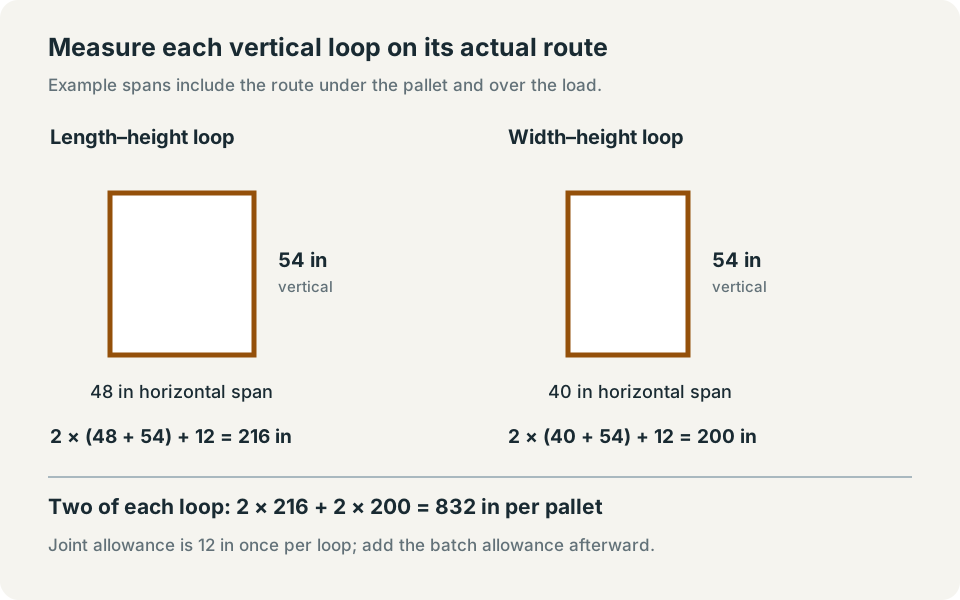
The model uses two rectangular vertical paths: a length–height loop and a width–height loop. Measure the actual outer spans the strap follows, including the under-pallet route where applicable. Load height above the deck alone may omit part of that route.
- Select inches or centimeters and enter the outer loop length span, width span and vertical span for one loaded pallet.
- Enter the number of identical pallets in the group.
- Enter the whole number of length–height loops and width–height loops per pallet. At least one loop direction must be used.
- Enter extra length for one joint. It is added once to each loop.
- Enter an additional percentage allowance and usable length per roll. These are your measured or chosen planning inputs.
One length–height loop = 2 × (length span + vertical span) + joint allowanceOne width–height loop = 2 × (width span + vertical span) + joint allowanceRequired length = total net loop length × (1 + additional allowance ÷ 100)Spans and usable roll length must be positive. Counts must be nonnegative whole numbers; joint and percentage allowances cannot be negative. A required individual loop longer than one usable roll is rejected. The model does not include a horizontal band or extra machine feed path unless it is represented by your entered allowance.
Worked example: ten pallets and two loops in each direction
Enter U.S. units with spans of 48 × 40 × 54 in, 10 identical pallets, 2 loops in each direction, 12 in extra per joint, a 10% additional allowance and 3,600 in usable length per roll.
| Step | Calculation | Result |
|---|---|---|
| One length–height loop | 2 × (48 + 54) + 12 | 216 in |
| One width–height loop | 2 × (40 + 54) + 12 | 200 in |
| Net per pallet | 2 × 216 + 2 × 200 | 832 in |
| Net for 10 pallets | 10 × 832 | 8,320 in |
| With additional allowance | 8,320 × 1.10 | 9,152 in |
| Required length in feet | 9,152 ÷ 12 | 762.666666… ft → 762.667 ft displayed |
| Minimum rolls by total length | ⌈9,152 ÷ 3,600⌉ | 3 rolls |
The tool rounds displayed lengths to at most 3 decimal places and rounds the roll count upward. Three rolls is a lower bound based on combined length. Offcuts, damaged strap and the actual cutting sequence may require additional rolls.
Record the complete specification before purchasing
Record material, width, thickness, grade, strap rating, joining method, joint performance and compatible tool model. Add the actual package, edge protection, strap path and handling conditions to that record. A roll's total length and a strap's strength are separate properties.
For a cost comparison, take verified purchase prices and consumed quantities to the packaging cost calculator. Keep any labor and setup costs separate so they are not counted twice.
Use the length result for purchasing, not restraint approval
Confirm the strap system for the actual load, then estimate the length for its approved pattern. Review the roll lower bound against a practical cutting plan. Packaging straps are not automatically vehicle tiedowns, and this consumption calculation does not establish transport securement compliance.
FAQs
Does the calculator select polypropylene (PP), polyester (PET) or steel?
No. It estimates length for the entered route. Select the strap, joint and tool as a compatible system for the package.
Will the minimum roll count always cover a job?
Not necessarily. The result is a total-length lower bound. Offcuts, damaged material and loop-by-loop cutting can require additional rolls.