
When an order already has a confirmed boxes-per-pallet capacity, the pallet count is a remainder problem. Divide the order quantity by that capacity, keep the complete multiples as full pallets, and place any nonzero remainder on one additional pallet.
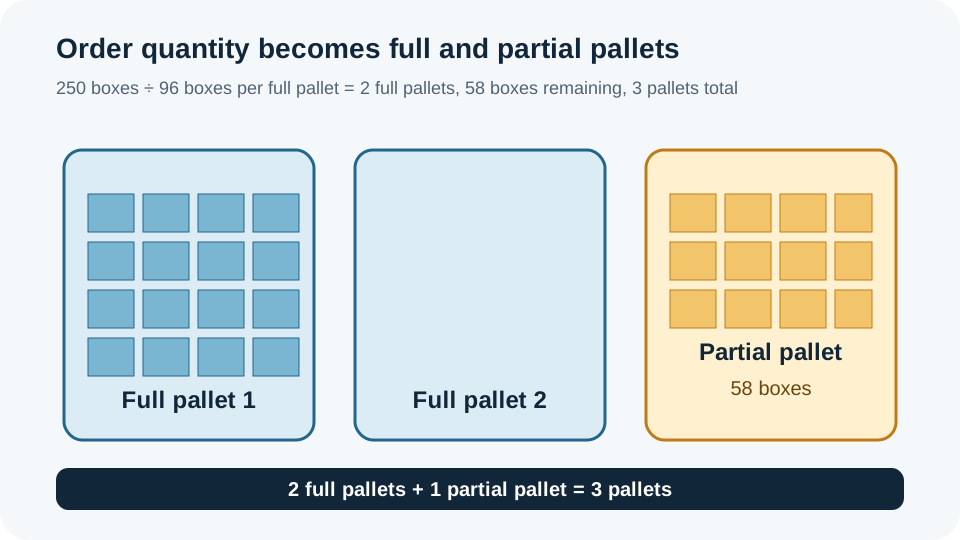
For 250 boxes at 96 boxes per full pallet, the order needs 2 full pallets, 58 boxes on a partial pallet, and 3 pallets total. The Pallet Quantity Calculator performs the same arithmetic for one or more separate order lines.
This guide starts with an established capacity. It does not recalculate how the cartons fit on a pallet; use the pallet loading guide for that earlier step.
Start with the confirmed capacity
Enter the number of boxes in the order and the number of boxes that one full pallet can hold. Both values are whole numbers. Capacity must be at least one, and an order quantity of zero produces zero pallets.
- Use the same unit of count.If the capacity is cartons per pallet, the order quantity must also be cartons. Do not mix cases, eaches, bundles or other units in one line.
- Use a capacity that matches the actual load.The calculator assumes height, weight, packaging and any required handling limits were already considered when the capacity was established.
- Add a separate line for each separate pallet requirement.Different stock-keeping units (SKUs) or order lines are calculated independently. Spare space on one line does not become capacity for another.
Separate full pallets and the tail
Full pallets = floor(order quantity ÷ boxes per full pallet)Boxes remaining = order quantity modulo boxes per full palletTotal pallets = full pallets + 1 when boxes remainWorked example: 250 boxes at 96 per pallet
| Input or step | Calculation | Result |
|---|---|---|
| Order quantity | Entered value | 250 boxes |
| Full pallets | floor(250 ÷ 96) | 2 full pallets |
| Boxes on the partial pallet | 250 − (2 × 96) | 58 boxes |
| Total pallets | 2 + 1 because 58 > 0 | 3 pallets |
The independent check is also ceil(250 ÷ 96) = ceil(2.604166667) = 3. The division keeps its unrounded value; only the final whole-pallet count is rounded upward.
Compare order lines without pooling
Separate lines preserve the calculator's rule that one line cannot use the unused space on another line's partial pallet. Keep lines separate when products must remain separated by product type, order, packaging or handling instructions.
| Order line | Quantity | Capacity | Full + tail | Line pallets |
|---|---|---|---|---|
| Line 1 | 250 boxes | 96 per pallet | 2 full + 58 tail | 3 |
| Line 2 | 100 boxes | 40 per pallet | 2 full + 20 tail | 3 |
| Combined total | 350 boxes | Two capacities | Lines stay separate | 6 pallets |
A simple pooled calculation using one capacity would answer a different question. The tool adds the six line-level pallets; it does not claim that 350 boxes can share a common 96-box or 40-box capacity.
Read the result and its limits
| Result | Meaning |
|---|---|
| Full pallets | Complete multiples of the entered capacity. |
| Partial pallets | One additional pallet for each line with a nonzero remainder. |
| Total boxes | The sum of the entered order quantities. |
| Total pallets | The sum of each line's full and partial pallet count. |
The result does not choose a carton layout, merge incompatible products, or prove that a partial pallet is physically stable. Keep the capacity basis with the order record so another person can reproduce the count.
Use the pallet quantity calculator
Enter each order line, verify its capacity, and check the full-pallet and tail-pallet outputs against the arithmetic above. When a line has no remainder, it uses only full pallets. When a line has any remainder, reserve one additional pallet for that tail.
For a capacity that still needs to be established, start with the pallet calculator and then bring its confirmed full-pallet capacity into this order-count step.
FAQs
Does a remainder always create a whole extra pallet?
Yes. Any nonzero remainder is counted as one partial pallet, even when only one box remains.
Can two separate order lines share a pallet?
No. The calculator keeps lines separate and adds their individual pallet counts.