
Freight density tells you how much gross weight occupies a given amount of shipping space. Divide the freight's gross weight by its outside volume. In U.S. customary units, the result is pounds per cubic foot (lb/ft³).
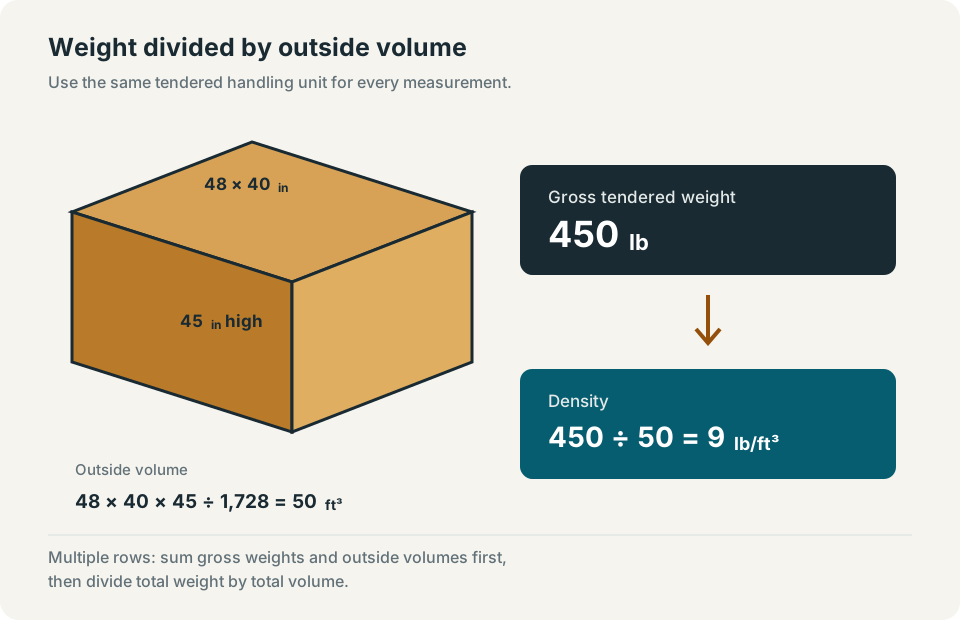
A handling unit measuring 48 × 40 × 45 in occupies 50 ft³. At 450 lb gross, its density is 9 lb/ft³. The freight density calculator performs this calculation for one or more rows and also displays kg/m³.
Density is a physical measurement. It does not, by itself, establish a carrier rate, dimensional weight or an official freight class.
Measure the freight as it will be handed to the carrier
A handling unit is a separately handled piece of freight, such as a loaded pallet. Measure the unit in its shipping condition, including the pallet, packaging and any projections that are part of it. Do not combine product-only weight with the dimensions of a complete loaded pallet.
- Select U.S. customary or metric input.U.S. mode uses inches and pounds; metric mode uses centimeters and kilograms. The selector applies to every row and converts existing entries when you change it.
- Enter outside length, width and height.Use the full rectangular envelope occupied by the unit. The example is 48 × 40 × 45 in, including the pallet.
- Enter gross weight per unit.Include the contents, pallet and packaging. The example is 450 lb for one complete unit.
- Enter the quantity of identical units.The dimensions and weight in a row apply to each unit, not to the row total.
- Add a row for a different size or weight.Calculate after reviewing all rows. The result uses summed volume and summed gross weight.
Every dimension and gross weight must be positive, and quantity must be a positive whole number. The form accepts rectangular envelopes; it does not subtract air gaps, hollow areas or empty space inside packaging.
Convert outside dimensions to cubic feet
Multiplying three inch measurements gives cubic inches. One cubic foot contains 12 × 12 × 12 = 1,728 cubic inches.
Volume per unit (ft³) = length (in) × width (in) × height (in) ÷ 1,728Row volume = volume per unit × identical-unit quantityFor the example, 48 × 40 × 45 = 86,400 in³, and 86,400 ÷ 1,728 = 50 ft³. Two identical units occupy 100 ft³. Their row weight must likewise be twice the per-unit gross weight.
Divide total gross weight by total volume
Shipment density (lb/ft³) = total gross weight (lb) ÷ total outside volume (ft³)Keep unrounded values through the calculation. For one example unit, 450 ÷ 50 = 9 lb/ft³. The tool then multiplies by 16.018463 to display metric density: 9 × 16.018463 = 144.166167, or 144.17 kg/m³ after rounding.
| Value | Rule |
|---|---|
| Centimeters to inches | Divide by 2.54 before calculating cubic feet. |
| Kilograms to pounds | Divide by 0.45359237 before adding gross weights. |
| Density in kg/m³ | Multiply the unrounded lb/ft³ result by 16.018463. |
| Displayed volume, weight and density | Round to at most 2 decimal places. Unnecessary trailing zeros may be omitted. |
The examples sometimes retain two decimal places to make comparisons easier to read. A displayed 9 and a written 9.00 represent the same value.
Worked example: 9.00 lb per cubic foot
Check the U.S. customary inputs
| Step | Inputs and calculation | Result |
|---|---|---|
| Outside volume | 48 × 40 × 45 in ÷ 1,728 | 50 ft³ |
| Gross weight | 450 lb × 1 unit | 450 lb |
| Density | 450 lb ÷ 50 ft³ | 9.00 lb/ft³ |
| Metric density | 9 × 16.018463 | 144.166167 → 144.17 kg/m³ |
Enter the same shipment in metric mode
The equivalent entries are 121.92 × 101.6 × 114.3 cm, 204.1165665 kg and quantity 1. These values convert back to the same 48 × 40 × 45 in envelope and 450 lb gross weight. The displayed results remain 50 ft³, 9 lb/ft³ and 144.17 kg/m³.
If your measurements are less precise, enter the values you actually measured. Extra decimal places in a unit conversion do not make the original measurement more accurate.
Combine unlike units without averaging densities
| Shipment | Total outside volume | Total gross weight | Density |
|---|---|---|---|
| One 48 × 40 × 45 in unit at 450 lb | 50 ft³ | 450 lb | 9.00 lb/ft³ |
| Two identical units of that size and weight | 100 ft³ | 900 lb | 9.00 lb/ft³ |
| One such unit plus two 24 × 20 × 45 in units at 150 lb each | 50 + 2 × 12.5 = 75 ft³ | 450 + 2 × 150 = 750 lb | 10.00 lb/ft³ |
In the last row, the large unit has a density of 9 lb/ft³ and each small unit has a density of 12 lb/ft³. Their shipment density is 750 ÷ 75 = 10 lb/ft³. Averaging the row densities would give a different, incorrect result because the rows occupy different volumes.
Keep density separate from billing and classification
Dimensional weight is a billing calculation that needs the applicable carrier divisor and rounding rules. Freight class requires the applicable National Motor Freight Classification (NMFC) item and governing provisions; handling, stowability and liability can matter as well as density. Neither result follows from a density measurement alone.
For irregular freight, confirm how the carrier requires the outside envelope to be measured. This tool always calculates rectangular volume and cannot determine a carrier-specific measurement exception.
Check the measurement before using the result
Use the density calculator after confirming the shipping dimensions, gross weight and number of identical units in each row. If the result will support classification, continue to the freight-class guide and confirm whether its density scale applies to the actual freight.
FAQs
Should I average the density shown for each row?
No. Add the gross weight and outside volume for all rows, then divide total weight by total volume. Averaging row densities can give the wrong result when the rows have different volumes.
Does a unit conversion change the physical density?
No. U.S. and metric inputs describe the same measurements. Small display differences can occur because the calculator rounds the displayed values, but it calculates from the unrounded conversions.
Sources
These references support the methods or rules used on this page. Check the version effective for your shipment date and any applicable carrier terms or item-specific provisions.