
Pallet linear feet estimates how much length a group of loaded pallets occupies along a vehicle floor. The calculation uses pallet footprint, usable equipment width and pallet count. It places each group in complete uniform rows and can compare the original and 90-degree rotated directions.
Ten 48 × 40 inch pallets in 96 inches of clear width use 20.000 ft in the original direction and 16.666667 ft when rotated. The calculator displays the shorter result as 16.667 ft.
This is a floor-length planning estimate. It does not create a freight rate, carrier billing rule or full loading optimization.
Measure the trailer floor
Use the loaded pallet envelope, including any overhang that occupies floor space. Enter the net usable width after clearance allowances rather than an unverified equipment label.
- Enter loaded pallet length and width.The example is 48 × 40 in. The original direction places 48 in along the vehicle.
- Enter pallet quantity.Use a whole nonnegative count. A zero group occupies no length.
- Enter usable width.The example uses 96 in. This is the width available to the entered footprint.
- Allow orientation comparison when appropriate.The tool compares two uniform grids; it does not mix directions within a group.
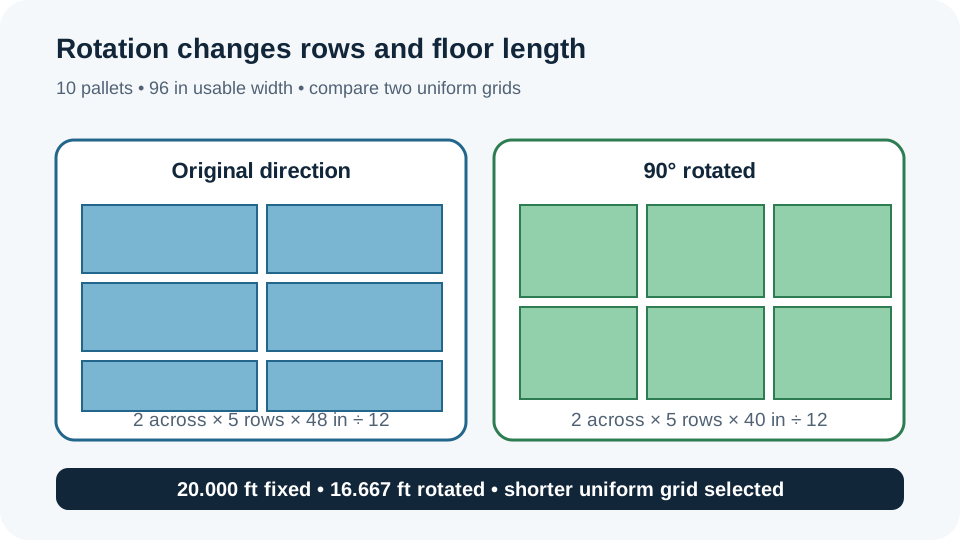
Compare pallet orientations
Across = floor(usable width ÷ pallet side across)Rows = ceil(pallet quantity ÷ across)Linear feet = rows × pallet side along the vehicle ÷ 12Worked example: 10 pallets in 96 inches
| Layout | Across | Rows | Length calculation | Displayed result |
|---|---|---|---|---|
| Original | floor(96 ÷ 40) = 2 | ceil(10 ÷ 2) = 5 | 5 × 48 ÷ 12 = 20 | 20 ft |
| Rotated | floor(96 ÷ 48) = 2 | ceil(10 ÷ 2) = 5 | 5 × 40 ÷ 12 = 16.666667 | 16.667 ft |
The calculator compares both feasible uniform grids and chooses the shorter one. The intermediate value 16.666667 ft is retained until the display layer rounds to three decimal places.
Read the planning limit
| Included | Not inferred |
|---|---|
| Loaded footprint, usable width, whole rows and pallet quantity | Carrier linear-foot billing or a quoted rate |
| Two uniform directions for each group | Mixed-orientation packing within one group |
| Sequential lengths for separate groups | Combining partially occupied rows between groups |
| Single floor level | Door constraints, unloading sequence or securement |
If the shipment contains different pallet footprints, enter each group separately. The calculator adds their sequential lengths, so an unused space at the end of one group is not silently reused by the next group.
Compare common orientation cases
| Loaded pallet footprint | Original result | Rotated result | Selected result |
|---|---|---|---|
| 48 × 40 in | 20.000 ft | 16.666667 ft | 16.667 ft rotated |
| 40 × 40 in | 16.666667 ft | 16.666667 ft | 16.667 ft either direction |
| 60 × 40 in | 25.000 ft | 16.666667 ft | 16.667 ft rotated |
Use the pallet linear feet calculator
Measure the loaded footprint and clear width, enter the whole pallet count, and compare the line describing each orientation. Use the selected result as a floor-length planning input, then review the actual loading and handling conditions separately.
For the number of pallets an equipment envelope can hold, continue to the truck or container capacity guide.
FAQs
Does rotating always reduce linear feet?
No. Rotation changes both the number of pallets across and the side used along the vehicle. The tool compares the two allowed uniform grids.
Can I add capacities from two equipment options?
No. Equipment or orientation results are alternatives. The calculator does not add alternative scenarios together.